


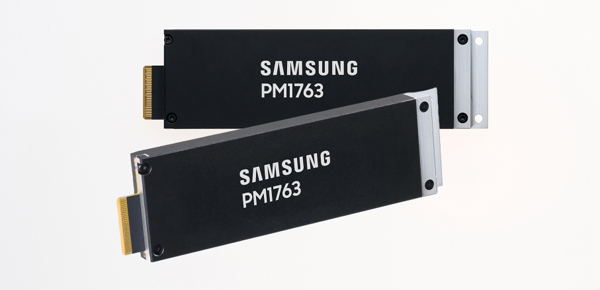
Samsung Unveils Next-Gen PCIe 6.0 SSD Built for AI and HPC Workloads
Samsung Electronics has officially announced the mass production of the PM1763, its pioneer PCIe 6.0-based enterprise solid-state drive (eSSD) engineered specifically for high-performance computing (HPC) and next-generation AI server environments. Built using Samsung’s 9th-generation V-NAND technology and a custom 4-nanometer controller, the PM1763 is designed to mitigate memory bottlenecks and satisfy the massive bandwidth demands of escalating AI training and inference workloads. Available in 4TB, 8TB, and 16TB capacities, the flagship 16TB drive achieves sequential read speeds of up to 28,400 MB/s and write speeds of up to 21,900 MB/s—more than doubling the sequential performance of its predecessor, the PM1753.
Samsung Partners With Barclays to Unveil First U.S. Credit Card
Samsung Commences Mass Production of PM1763 PCIe 6.0 Enterprise SSD to Accelerate Next-Gen AI Infrastructure
This generational leap in processing speed allows systems to transfer a 40GB large language model (LLM) in approximately 1.4 seconds, drastically reducing latency between processors and GPU accelerators. In addition to raw performance, the PM1763 brings significant architectural efficiency to data centers. It improves overall power efficiency by more than 1.8 times compared to the prior generation and integrates direct-to-chip (D2C) liquid-cooling support, enabling sustained peak performance within modern, high-density server racks without thermal throttling.
To safeguard sensitive enterprise models and virtualized environments, Samsung has also fortified the drive with advanced enterprise security protocols. The PM1763 natively supports post-quantum cryptography (PQC) algorithms to counter future quantum computing threats, along with the TEE Device Interface Security Protocol (TDISP) for secure data paths. According to Jangseok Choi, VP and Head of Memory Product Planning at Samsung Electronics, the validated PM1763 is strategically positioned as a core infrastructure component that will allow enterprise clients to scale memory capacity smoothly and optimize AI deployment costs.
Pakistan’s Local Mobile Phone Production Falls 8% in H1 2026 as Imports Surge 197%


