


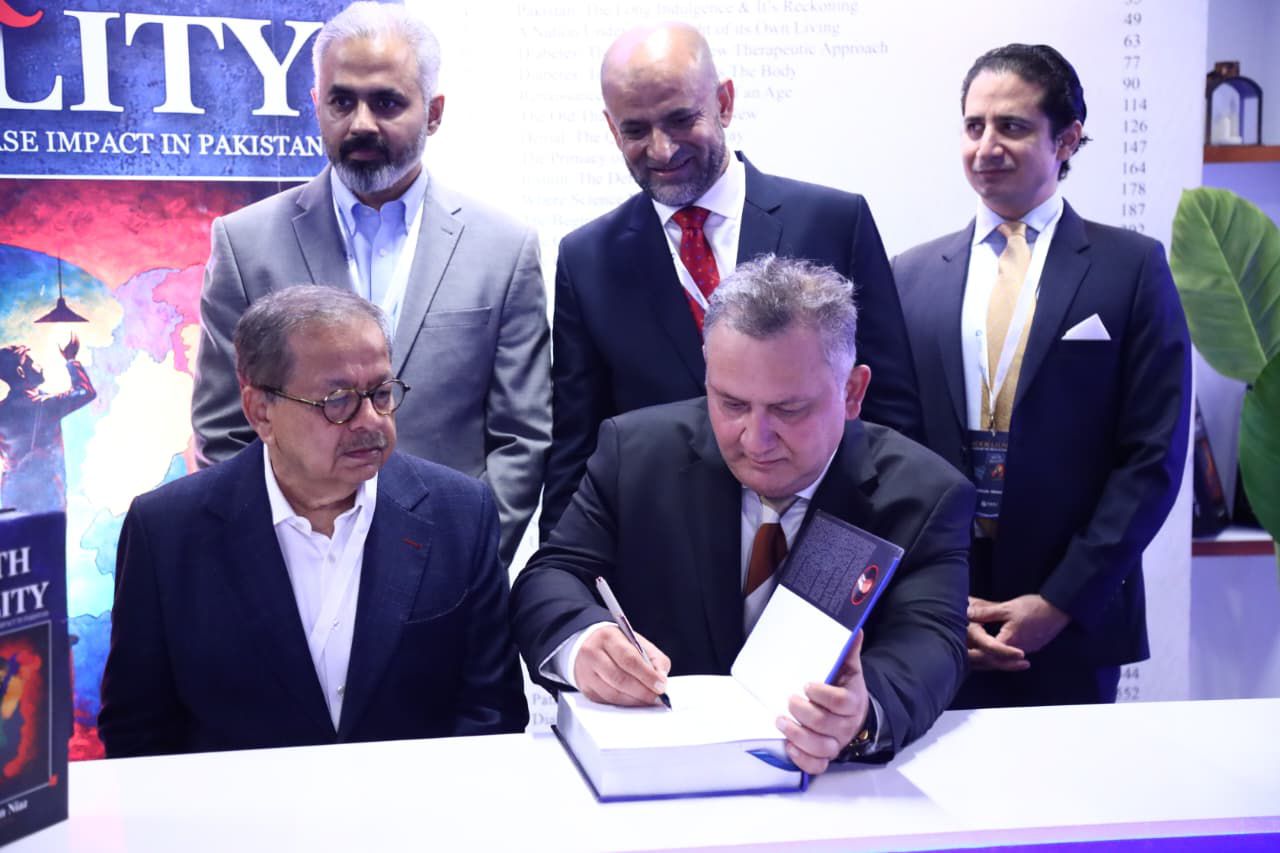
Few countries bear a heavier burden of Type 2 Diabetes than Pakistan. With tens of millions living with the disease and an unknown but substantial number yet undiagnosed, its consequences extend well beyond the consulting room — straining healthcare infrastructure, depleting family finances, and arriving in many patients’ lives too late, with too little context and too few resources. Dr. Nauman Niaz’s nineteenth book is a direct response to that burden. It does not approach the subject with academic detachment; it engages the crisis as it exists on the ground.
The book’s most immediately striking feature is its visual character. Every image contained within it was conceptualised and executed as an original hand-painted work — created through human craft and deliberate artistic intent before being committed to print. This is a conscious departure from an era in which AI-generated imagery is available on demand. The paintings are human in origin, purposeful in design, and inseparable from the arguments they accompany. They are not ornamental. They are central to what the book is — and in the context of contemporary medical publishing, they mark it as something genuinely distinctive.
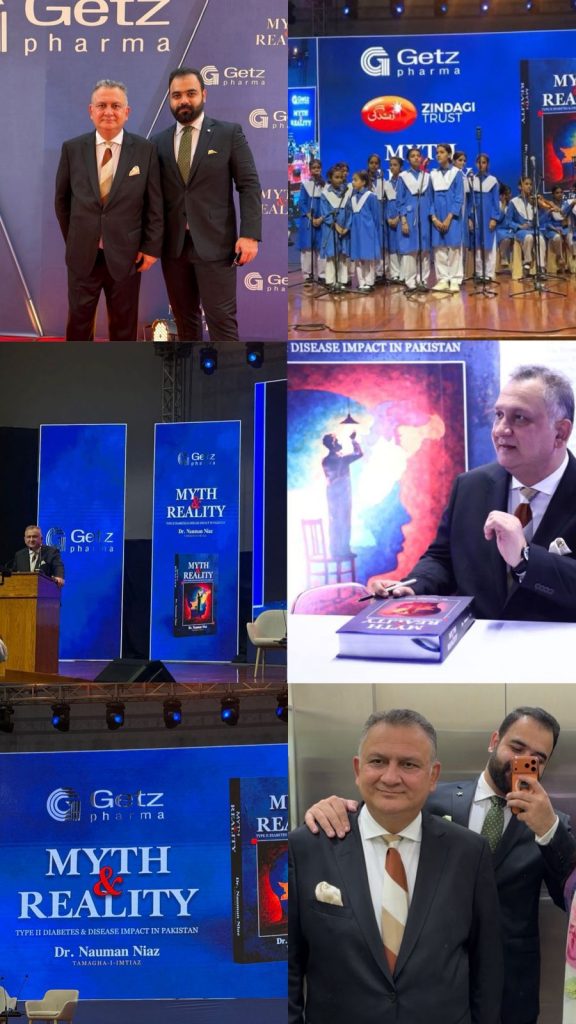
Myth & Reality was published under the auspices of Getz Pharma, an initiative conceived not as a commercial venture but as a contribution to society. The project reflects the values of Khalid Mahmood, Executive Chairman of Getz Pharma — a figure recognised as much for progressive entrepreneurship as for sustained civic investment. He has funded schools, playgrounds, and philanthropic programmes; his interests span publishing, poetry, calligraphy, art, and music; and he remains among the principal benefactors of the Zindagi Trust, which champions artistic development, vocational education, and emerging talent.
Two distinct motivations shaped the book’s creation. The first is one of personal and professional legacy. Dr. Niaz built his public reputation through cricket, where his writing and expertise have earned wide recognition over many years. Yet a parallel aspiration persisted throughout: to make a substantive contribution to endocrinology — the discipline that underpins his professional identity. That aspiration is now realised in this volume.
The second motivation is literary and intellectual in nature. Educated on the canonical medical texts — Harrison, Cecil, P. J. Kumar — Dr. Niaz recognised their authority while also noting their limitations for the non-specialist reader. His own approach combines clinical data, genuine patient scenarios, and current evidence in the fields of diabetes and obesity with art, literature, and expressive prose. The result is a work of reference that is rigorous in content and accessible in form.
Accessibility is a deliberate design principle. The book addresses multiple audiences simultaneously: patients seeking to understand their diagnosis; medical students and educators; pharmacists and pharmaceutical professionals; and specialist clinicians in search of a reference that integrates evidence with broader cultural and human context. It is neither reductive in its clarity nor remote in its precision.
Several chapters stand apart from anything conventionally found in endocrinology texts. One examines elite international athletes who manage Type 2 Diabetes at the summit of competitive sport — a study in physiological discipline, strategic adaptation, and identity beyond diagnosis. Another addresses, with candour and without condescension, the widespread reliance across Pakistan on homeopathic, herbal, hakim, and fraudulent practitioners — a reality that shapes the lives of millions and that evidence-based medicine cannot afford to ignore.
Myth & Reality: Type 2 Diabetes is a work of lasting reference — for the physician in training, the patient navigating a new diagnosis, and any informed reader with a stake in understanding one of Pakistan’s most pressing public health challenges. Dr. Nauman Niaz has approached his nineteenth book with the same underlying conviction that has distinguished all those preceding it: that writing pursued with seriousness and genuine care has the power to change how we see the things that matter.


