


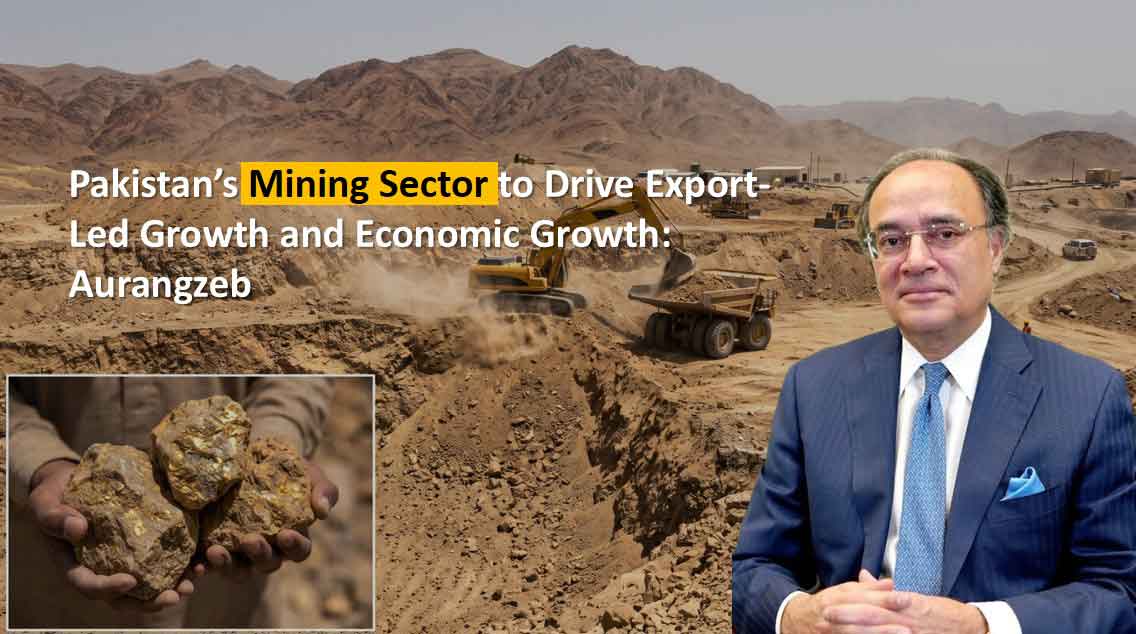
Pakistan’s Mining Sector to Drive Export-Led Growth and Economic Growth: Aurangzeb
Minerals and Mining Key to Pakistan’s Sustainable Economic Growth
ISLAMABAD, November 12 (APP): Federal Minister for Finance and Revenue Muhammad Aurangzeb has said Pakistan’s minerals and mining sector will play a crucial role in driving sustainable economic growth, boosting exports and attracting foreign investment.
Addressing the two-day Pakistan Minerals Investment Forum 2026 (PMIF26), the finance minister said the country had made significant progress towards macroeconomic stability and was now focused on achieving sustainable, export-led growth through structural reforms and investment in productive sectors.
Pakistan Reduces Twin Deficit to 2.6% of GDP
Highlighting the government’s economic achievements, Aurangzeb said Pakistan had reduced its twin deficit from around 12.5% of Gross Domestic Product (GDP) a few years ago to 2.6% by the end of June 2026.
He said the fiscal deficit had reached a 22-year low, while the country had recorded primary surpluses for three consecutive years.
Pakistan had also strengthened its external position, increasing foreign exchange reserves to $21.5 billion, equivalent to slightly more than three months of import cover.
The minister described these reserves as the highest in the country’s history, adding that improved fiscal and external buffers had helped Pakistan withstand economic shocks, including the October 2025 floods and the ongoing conflict in the Gulf region.
Credit Rating Upgrades Boost International Investor Confidence
Aurangzeb said international confidence in Pakistan’s economy was reflected in three credit rating upgrades since April 2025 and the country’s successful return to international capital markets.
He recalled that Pakistan had raised $750 million through a private placement in April 2026, accessed the Chinese capital market through its inaugural Panda bond in May, and issued $3 billion in Eurobonds in September after a gap of around four years.
The Eurobond issuance received bids worth twice the amount offered, with participation from major investors in Europe, the United States, Asia and the Middle East.
Government Pursuing Structural Reforms and Privatisation
The finance minister stressed that sustaining economic stability required deep structural reforms rather than temporary measures.
He said the government was pursuing reforms in taxation, energy, public finance, pensions and tariffs, while promoting privatisation and reducing the role of inefficient state-owned enterprises.
Aurangzeb added that 26 state-owned entities had been handed over to the Privatisation Commission as part of efforts to strengthen private-sector participation in the economy.
Pakistan Targets 4% Economic Growth Through Exports
The minister said Pakistan would avoid consumption-driven growth based on imports, which had repeatedly created balance-of-payments pressures and forced the country to seek external financial assistance.
Instead, the government was pursuing export-led growth, supported by lower taxation for exporters and financing rates ranging between 4.5% and 6%.
Aurangzeb said the government projected economic growth of 4% for the current fiscal year, following growth of nearly 3.7% last year.
He also highlighted the potential of information technology exports, saying IT export services were expected to reach around $5 billion during the current fiscal year.
Investor Confidence and PIA Privatisation Highlighted
Emphasising the importance of investor confidence, Aurangzeb said macroeconomic stability, predictable policies and the ability to repatriate profits and dividends were essential for attracting foreign direct investment.
He cited the privatisation of Pakistan International Airlines (PIA) as an example of growing confidence among domestic investors, saying two major business groups had submitted bids collectively worth nearly $1.2 billion.
Mining Project Expected to Generate $2.8 Billion in Exports
Turning to the minerals sector, Aurangzeb said a single mining project was expected to generate $2.8 billion in export proceeds once it entered commercial operations.
He said the project alone could contribute around 10% of Pakistan’s existing total goods exports.
Although the project had faced delays, the finance minister expressed confidence in its financing arrangements, describing its syndicated financing as the largest in Pakistan’s history.
Tethyan Belt Offers Major Potential for Copper Exports
The minister also highlighted the potential of the Tethyan Belt, saying Pakistan’s mineral resources could help address the expected global shortage of copper as countries accelerated their transition towards cleaner energy.
He described minerals and mining as among the most important sectors for transforming Pakistan’s economy and achieving sustainable economic growth.


