


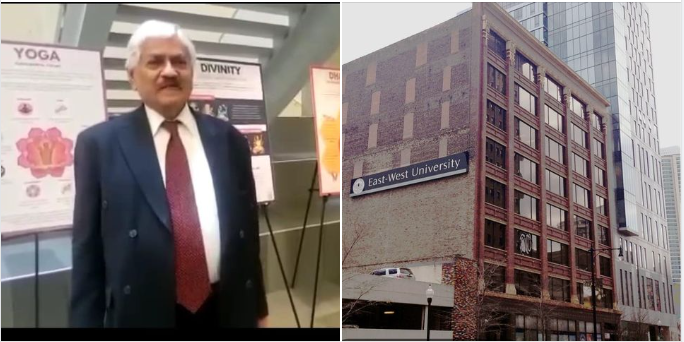
It might surprise you, as it did me, to learn that in 1980, a Pakistani doctor named Wasiullah Khan founded a private university in Chicago, USA, known as East-West University. Over the past 42 years, this university has been steadily growing and developing.
Launch of the ‘Youth Council for Sustainable Action’ and BOLO Health
Dr. Wasiullah Khan hails from Bahawalpur and was a Deputy Secretary in the Punjab Department of Education in the 1970s. He received a scholarship to pursue his PhD in the USA and later taught at various universities there. During this time, he returned to Pakistan and met with the renowned scholar Syed Abul A’la Maududi. In their meeting, they discussed the educational challenges faced by Pakistanis and other minorities in America. Maududi advised Dr. Wasi to establish a private university there.
Dr. Wasi consulted with seven like-minded friends in the USA, including professors, businessmen, and doctors. They collectively raised funds to register the university. Initially, the university started with only 23 students. Later, a Saudi prince donated $100,000, and a Pakistani-American businessman named Riaz donated $1 million. Today, the university’s assets are valued at $125 million.
Pakistan Faces Brain Drain Crisis with 2.2 Million Leaving in 18 Months
While universities in Chicago and other American cities charge between $70,000 and $90,000 in tuition fees for a degree, East-West University charges a maximum of $22,000. The university attracts students from many countries, with the highest number coming from Pakistan and India.
by: Prof. Dr. Fakhr-ul-Islam
- LUMS Hosts National Workshop to Boost Local Power Equipment Manufacturing in Pakistan
- LUMS Launches CAPE to Identify Major Sources of Air Pollution Across Punjab
- HEC, National CERT Sign MoU to Strengthen Cybersecurity Across Higher Education Sector
- LUMS calls for trauma-informed approach to improve student well-being
- Sindh Government, LUMS and AKU Sign Pact to Integrate AI into Maternal and Child Healthcare
- LUMS Workshop Charts Path to Net‑Zero Electricity by 2040


